
Hartford Parole Release Path
The CT DOC Division of Parole and Community Services supervises and supports people released to the community under authority of the Commissioner of Correction and the Connecticut Board of Pardons and Paroles. The Hartford district office is one local point in that statewide structure. It may be relevant when a DOC record indicates parole, special parole, transitional supervision, or another community status.
Release to the Hartford office does not mean the person is held at 300 Sheldon Street. It means secure confinement has changed to community supervision. A person may live in the community, enter a structured program, or receive specialized supervision. The release record should identify the date and status. The Board or court record explains the legal authority, while the district office handles supervision after the person enters the community.
Verify Hartford Parole Status
Begin with the CT DOC Inmate Information Search. Search by DOC inmate number when possible, or use name and date of birth. A current correctional facility means the person has not yet moved into ordinary community supervision. A release or parole-related status is a lead. CT.gov warns that public status can lag, so compare it with the court case and the appropriate parole source.
- Record the DOC number, exact status, release-date text, and last listed facility.
- Check Connecticut VINELink for a custody-change result or notification.
- Review the Board of Pardons and Paroles hearing information when parole was considered.
- Read the Judicial Branch case for special parole, probation, sentence, or violation terms.
- Call the Hartford district office for proper supervision routing when the record points there.
Parole and probation are different. Parole is tied to CT DOC and the Board. Special parole is a court-imposed form of post-prison supervision administered through DOC. Probation is a court sentence supervised through the Judicial Branch Court Support Services Division. A person may have more than one form at different points. Use the exact term in the record.
The Hartford release search and record path is the better route when the underlying custody is unclear. Hartford Police, CT DOC, federal custody, and immigration custody do not share one roster.
Hartford Parole Office Contact
The district office contact comes directly from CT DOC. Use it for parole and DOC community-supervision routing after a record indicates the person has been released into that system. Do not call it for a Hartford Police arrest report, a prison booking photo, or a court-file copy. Those records belong to other offices.
Hartford Parole and Community Services
300 Sheldon Street
Hartford, CT 06106
Phone: (860) 297-4400
Fax: (860) 297-6599
CT DOC Parole and Community Services
24 Wolcott Hill Road
Wethersfield, CT 06109
Phone: (860) 692-6901
The official Hartford office directions page supplies the address and phone. Have the full name, DOC number, date of birth if known, release date, and court docket ready. Public access to detailed supervision information can be limited. Ask the office to confirm the correct public route rather than seeking private case-management details.
Note: The office may route a public question without disclosing a person's residence, schedule, treatment, or other protected supervision details.
Hartford Community Supervision Records
The correctional record and supervision record answer different questions. A CT DOC discharge or release status shows the change from secure custody. A Board decision can show whether parole was granted, denied, deferred, rescinded, or reviewed. The court docket may impose special parole or probation. The Hartford district office manages the ongoing community status after the release becomes effective.
| Record source | Release question answered |
|---|---|
| CT DOC inmate information | Current facility, custody status, and release-date lead |
| CT DOC Public Information | Formal offender, release, discharge, or transfer clarification |
| Board of Pardons and Paroles | Parole hearings, eligibility, and board process |
| Judicial Branch docket | Sentence, special parole, probation, and violation terms |
| Hartford district office | Local post-release supervision routing |
The Board of Pardons and Paroles posts hearing and eligibility resources. Its hearing calendar uses date-specific links, and hearings generally start at the time posted. No separate searchable statewide decision-results database was found in the research. A current outcome may require the hearing materials, a public records request, the DOC status, and the court or supervision record.
Viewers may not make their own recording of a Board livestream. The Board directs public requests for an official hearing copy through its Freedom of Information route. This distinction matters when a hearing was held but a public link has changed or expired.
Hartford Parole Versus Probation
A jail release can lead to either system, and sometimes both at different stages. Parole generally permits a person to serve part of a prison sentence in the community under correctional and Board authority. Special parole follows a prison term when imposed by the court. Probation is ordered by the court and supervised through CSSD. None should be inferred solely because the person no longer appears at Hartford Correctional Center.
- Parole
- Conditional release into community supervision before the correctional sentence fully ends.
- Special parole
- A court-imposed period of DOC supervision that follows incarceration.
- Probation
- A court sentence supervised outside prison through the Judicial Branch.
- Discharge
- The formal end of the stated custody or supervision authority.
For parole, preserve the DOC number and check Board materials. For probation, preserve the docket number and work through the court. A Board hearing does not establish a probation term, while a criminal docket does not by itself confirm that DOC has processed a parole release. Compare sources before contacting the district office.
A violation can also return a person to custody. The docket or Board process may show a violation, revocation, or rescission. An old “released” status may therefore be accurate for one date yet not describe current custody. Run a fresh CT DOC and court check.
Note: “Out of jail” describes place, while parole, special parole, and probation describe separate legal forms of supervision.
Hartford Parole Release Support
CT DOC Offender Reentry Services says each facility has a full-time reentry counselor and that more intense preparation begins well before release. Reentry staff coordinate with Parole and Community Services and the Judicial Branch Court Support Services Division. The state material also references Hartford and Waterbury welcome-center resources through Community Partners in Action. These services are navigation and reentry channels, not proof of custody status.
The official Parole and Community Services overview shows the division's district and specialized structure.
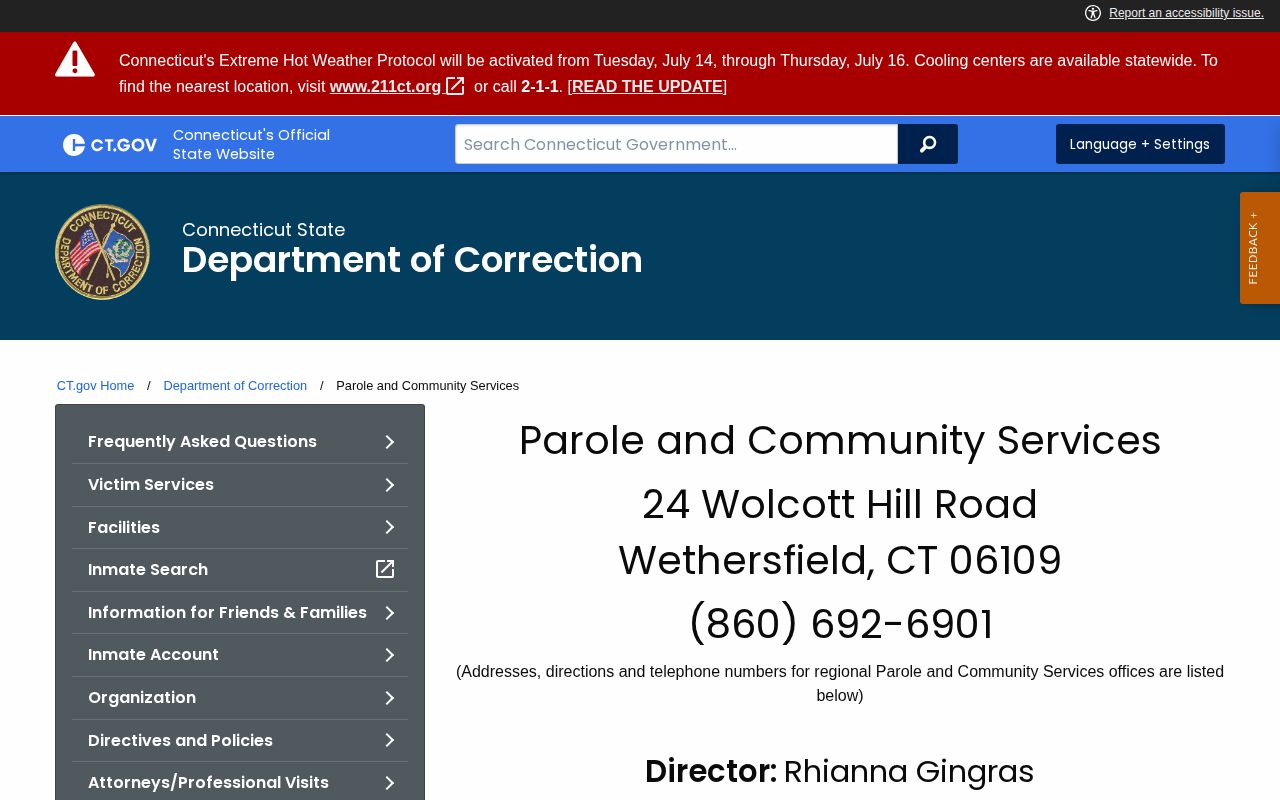
The captured state page provides supervision context. Individual release confirmation still rests on the person's DOC, Board, and court records.
Specialized units named by CT DOC include Residential Services, Central Intake, Special Management, Mental Health, Fugitive Investigations, DUI, Women's Re-Entry, Support Services, and Training. A specialized assignment should not be guessed from a charge or prison location. Use the public agency route only when a record or authorized contact points to it.
Hartford Parole Safety Concerns
CT DOC lists a Fugitive Investigations Unit for parole and community-supervision absconder concerns. The published number is (203) 346-7830, and the state page lists Stephen.Faiella@ct.gov as an anonymous tip email. That route is more appropriate than trying to infer absconder status from a stale jail roster or an old release date.
An absconder is a person alleged to have left supervision or failed to remain available as required. It is not a label to apply based on rumor, a missed online result, or an old address. Agency and court records control. For an immediate emergency, use emergency services rather than a records search.
VINE can provide custody-change notices, but it is not a complete supervision database. If VINE says released while CT DOC or a court shows a later violation hold, the more recent agency record may reflect the current state. Ask the proper office to reconcile the dates.
Hartford Jail History and Parole
Older Hartford jail language predates the present structure. Connecticut unified county jails and state prisons under CT DOC in 1968, and Hartford Correctional Center opened as a Level 4 state pretrial facility in 1977. The old Seyms Street jail history helps explain why searches still use “Hartford County jail” even though modern custody and parole records are statewide.
This does not make the Sheldon Street parole office an old jail or a historic detention site. It is a modern supervision office. The history matters only because it changes where records are kept. Current release status begins with CT DOC, not a county sheriff. Post-release parole routing then moves to the Board, the Hartford district, and other state units as the record requires.
Keep the sequence clear: arrest or court action, secure custody, legal release, community supervision, then eventual supervision discharge. Each stage has its own agency and record. A person may be released from prison without being discharged from all state control.