
UConn Medical Ward Release Paths
The CT DOC Medical-Surgical Ward at UConn Health is a secure medical custody channel. It is not a county jail, a public hospital roster, or an independent Hartford release list. CT DOC identifies the unit as a co-ed inpatient and outpatient program at the University of Connecticut Health Center in Farmington. Hartford Correctional Center oversees it. A person at the ward remains within the DOC custody framework even though treatment occurs at a health center.
A departure from the ward can follow several paths. The most common record question is whether the person returned to Hartford Correctional Center or another state facility. A person may also move to a different medical or custody arrangement. Actual discharge can occur if a sentence expires, a court orders release, parole or community supervision begins, or another lawful release basis applies. A warrant or detainer may instead send the person to another agency. The destination field and current CT DOC status matter more than the fact that the ward stay ended.
Confirm a UConn Ward Release
Use the CT DOC Inmate Information Search as the first public check. It accepts a CT DOC inmate number, last name, first name, and date of birth. The inmate number is the safest key when known. A current facility result means the person remains in DOC custody even if the result no longer names the medical ward. A release, discharge, parole, or past date is a lead that needs court or records confirmation.
- Search the CT DOC number alone, or use a name and date of birth.
- Record the exact status, facility, and release-date language shown.
- Check Connecticut VINELink for a reported custody change.
- Review the Judicial Branch case for a court order, sentence, bond, or supervision term.
- Contact CT DOC Public Information when the ward move and custody outcome remain unclear.
CT.gov cautions that release dates are subject to change and computer status may lag. A missing ward label can simply mean the person went back to a regular DOC custody site. A no-match can have other causes, including a name variant, federal or immigration custody, erasure, or delayed processing. Do not ask UConn Health for a public patient directory entry to settle correctional status. The controlling records belong to CT DOC and the court.
Note: Compare the date of the ward departure with the date and status in the correctional record before calling it a release.
UConn Ward Records Contact
The research lists the ward at UConn Health in Farmington but does not provide a separate public ward phone for offender release information. Route custody and discharge questions through CT DOC. Hartford Correctional Center can help with facility routing because it oversees the ward, while the Public Information Office handles broader offender-information questions and formal record access.
CT DOC Medical-Surgical Ward at UConn Health
University of Connecticut Health Center
Farmington, Connecticut
Secure CT DOC medical custody unit
Overseen by Hartford Correctional Center
CT DOC Public Information Office
24 Wolcott Hill Road
Wethersfield, CT 06109
Phone: (860) 692-7780
Monday through Friday, 8:00 a.m. to 4:30 p.m.
A focused request should include the full name, date of birth if known, DOC inmate number, dates of custody or treatment, court docket, and the record needed. Ask whether the person returned to a CT DOC facility, discharged, transferred to another authority, or entered community supervision. Medical details can be confidential even when a custody date or location is public. Keep the request on the release and custody fields rather than seeking protected health information.
The CT DOC offender-information page provides the state contact route. For an uncertain release calculation, the Sentence Calculation and Interstate Management unit and Central Records are the more suitable backstop. They manage sentence calculations, central records, interstate functions, and earned-credit work.
UConn Ward Custody Facts
Two official CT DOC pages describe the ward with different bed totals. The Hartford Correctional Center page refers to a twelve-bed medical-surgical ward, while the separate ward-unit page describes ten beds. Because both are state sources and the figures conflict, the defensible description is simply “the CT DOC Medical-Surgical Ward at UConn Health.” The bed count should not be used to identify a present patient or to infer occupancy.
The official CT DOC UConn Ward Unit page describes a Level 5 co-ed inpatient and outpatient setting. That security description underscores the key point: the ward is part of correctional custody. It serves medical needs while DOC remains the records authority. The site is not open as a public inmate visiting list, and a hospital record is not the release record.
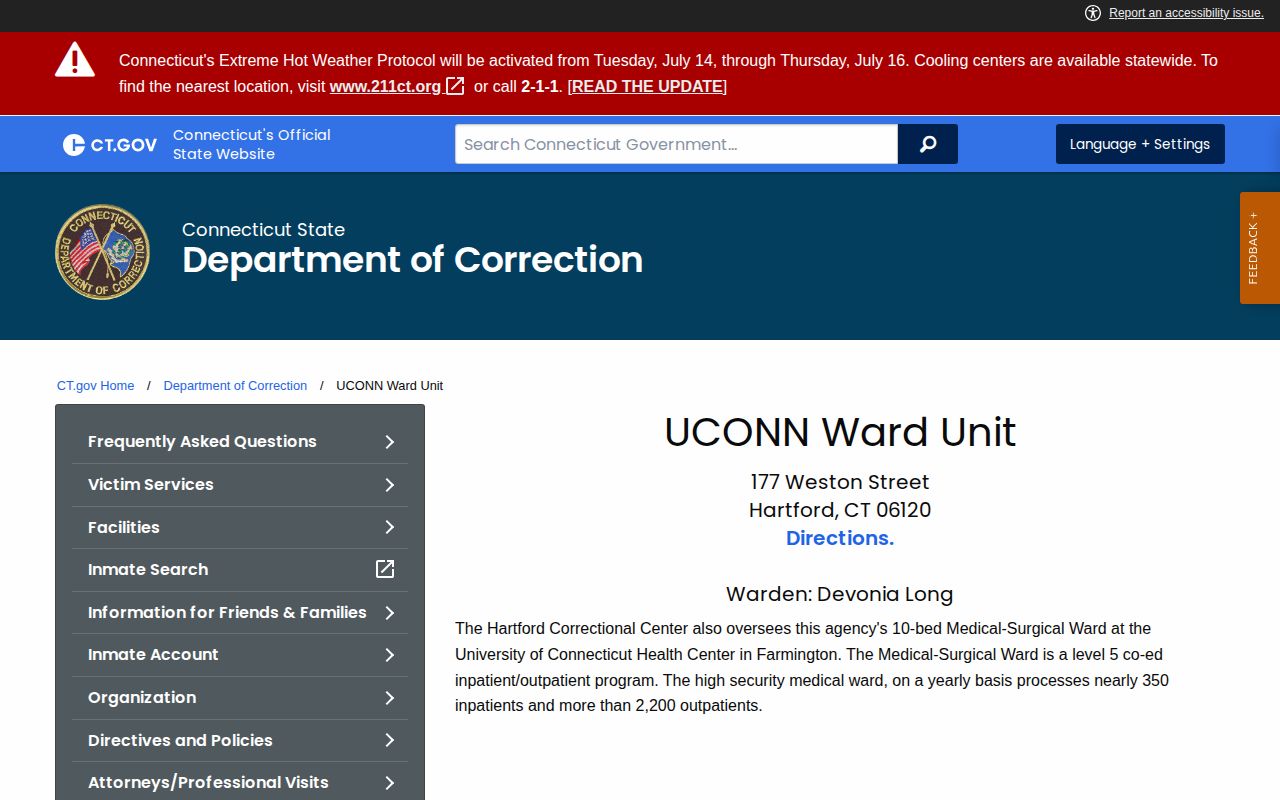
The captured official ward page helps establish the unit's correctional role. Release status must still be read from the inmate, court, and DOC records tied to the individual.
- Medical transfer
- Movement for care while correctional custody continues.
- Discharge
- End of a stated correctional custody term or authority.
- Detainer
- A hold or request that can shift custody to another agency.
- Community supervision
- Correctional control outside a secure facility, including parole-related statuses.
Hartford Ward Court Records
A medical placement does not erase the court source of the detention. Review the Connecticut Judicial Branch docket for bond changes, court orders, sentence terms, jail credit, probation, violations, and other events that may affect the release. The docket may explain why a person remained held after treatment ended or why CT DOC discharged the person on a particular day.
Hartford Correctional Center serves superior courts in Bristol, Enfield, Hartford, Manchester, Middletown, New Britain, Rockville, and West Hartford. A person overseen through Hartford CC may therefore have a controlling docket outside the city. Search by defendant and docket number rather than assuming one courthouse. When multiple cases exist, check each for a bond, warrant, mittimus, sentence, or hold.
Pretrial and sentenced cases behave differently. A pretrial person may leave under bond or a court order without completing the case. A sentenced person may have an estimated release date that changes with jail credit, earned credit, a new sentence, a disciplinary action, or parole. A court release order and a medical discharge note answer different questions and should not be merged.
Note: The court explains legal authority, while CT DOC records show whether that authority resulted in release, transfer, or continued custody.
UConn Ward Release Records
A useful CT DOC release record identifies the person, DOC number, custody location, admission information, status, release date when recorded, release type, and destination or transfer agency where maintained. Ask for the narrow record that answers the question. A request for discharge status need not seek clinical notes. Records staff can separate correctional information from exempt or private medical material.
Connecticut FOIA begins from public access to agency records unless another law applies. That does not open all health, juvenile, safety, or security information. It also does not guarantee that an online inmate result will preserve every historical ward stay. A direct CT DOC request may be needed when a person has moved, when the online status is stale, or when the public view no longer names the ward.
| Question | Best record |
|---|---|
| Is the person still in DOC custody? | CT DOC inmate status and Public Information confirmation |
| Did the person leave the ward? | DOC movement or custody record |
| What legal act drove release? | Judicial Branch docket or order |
| Was custody changed or released? | VINE alert plus DOC verification |
| Did supervision follow? | DOC Parole and Community Services or the court probation record |
The Hartford release search and records overview can help when the person entered through Hartford Police, moved through another CT DOC institution, or shifted into a federal or immigration track. A ward page alone cannot resolve those separate systems.
UConn Ward and Hartford History
Hartford's correctional vocabulary predates the present statewide system. Connecticut unified county jails and state prisons under CT DOC in 1968, and Hartford Correctional Center opened in 1977 as a state pretrial facility. Searches for an old “Hartford jail hospital” or county ward can therefore point toward a government structure that no longer describes current custody.
The historical distinction matters without making the medical ward itself a historic jail. The UConn unit is a modern secure treatment location. Its connection to Hartford comes from Hartford Correctional Center oversight and the statewide path for Hartford-area detainees. Present release confirmation goes to CT DOC, VINE, and courts, not a county sheriff archive.
A person who leaves secure medical care may next enter a regular correctional site, community supervision, residential services, federal custody, immigration custody, or the community. Read the next status rather than presuming the last setting. This keeps the record accurate and respects the sharp line between health care, correctional placement, and legal release.