
Residential Services Release Path
The CT DOC Division of Parole and Community Services includes a Residential Services Unit in Hartford. Its role is connected to supervision and reentry after secure custody. It does not hold the public inmate roster for Hartford Correctional Center, and it does not issue a police arrest record. A person associated with residential services has generally moved into a community-based correctional stage.
That move can still carry rules and state oversight. “Released” may mean released from a secure prison or correctional center, not discharged from the sentence or all correctional control. The person may enter a halfway house, another structured placement, or supervised community program. Later movement out of one residence also does not by itself prove the end of supervision. The DOC status, parole authority, court sentence, and final discharge record must be read together.
Verify Residential Release Placement
Start with the CT DOC Inmate Information Search. Use the inmate number when available, then name and date of birth. A current prison or correctional center means the person remains securely confined. A release, parole, transitional, or community status may point toward residential supervision. CT.gov warns that status and release-date information can lag or change, so a single public screen is not final.
- Gather the DOC number, full name, date of birth, release date, and court docket.
- Save the exact CT DOC status and last facility listed.
- Check Connecticut VINELink for a custody change or release notification.
- Read the court docket and Board material for parole, special parole, or probation terms.
- Use the Residential Services Unit contact to route a public placement or supervision question.
Do not use a no-match to infer that a person resides at a particular program. A missing result may reflect a short police event, a name variation, a federal or immigration track, erasure, or a delayed update. Public information about a person's exact residential placement may also be limited. Ask only for the public status and correct agency route.
The Hartford released-inmate search and records path helps separate police, state, federal, immigration, and supervision records. This unit applies only to a narrow post-release stage.
Residential Services Unit Contact
CT DOC lists the Residential Services Unit at 286 Sheldon Street, close to the Hartford Parole and Community Services district office. Both use the same published main phone number, but they have different fax numbers and functions. Use the Residential Services Unit contact when the record specifically indicates a structured placement or residential-services issue.
Parole and Community Services Residential Services Unit
286 Sheldon Street
Hartford, CT 06106
Phone: (860) 297-4400
Fax: (860) 297-6523
Hartford Parole and Community Services
300 Sheldon Street
Hartford, CT 06106
Phone: (860) 297-4400
Fax: (860) 297-6599
The official Residential Services Unit directions page is the source for this address. Have the DOC number, release date, court docket, and exact status ready. The office is not a general locator for any released Hartford resident. It can route questions tied to CT DOC community supervision and residential services.
Note: The close street addresses do not make the district office and Residential Services Unit interchangeable; identify the record's supervision route first.
Hartford Residential Release Records
A correctional discharge record should establish when the person left secure custody and what status followed. The Board record may show a parole decision. The court docket may impose special parole or probation. The Residential Services Unit is most useful when those records point to a structured placement under CT DOC community supervision.
| Source | What it can confirm |
|---|---|
| CT DOC inmate information | Last facility, public status, and release-date lead |
| CT DOC Public Information | Formal release, transfer, discharge, or community-status clarification |
| Board of Pardons and Paroles | Parole hearing and eligibility process |
| Judicial Branch docket | Sentence, special parole, probation, and violation terms |
| Residential Services Unit | Public routing for a residential supervision status |
The CT DOC Parole and Community Services page describes district and specialized units. Residential Services is one specialized function alongside Central Intake, Special Management, Mental Health, Fugitive Investigations, DUI, Women's Re-Entry, Support Services, and Training. The correct unit depends on the actual assignment, not on the underlying charge alone.
A request for an older or disputed release should go to CT DOC Public Information or Central Records rather than to a residential placement. The state offender-information number is (860) 692-7780 during published weekday hours. Give the DOC number and precise date range, and ask whether the event was release, transfer, parole, residential placement, or final discharge.
Residential Placement Versus Custody
The key difference is physical setting. Secure custody places the person in a prison, correctional center, or secure ward. Residential services may place the person in a structured community site while supervision continues. Ordinary community parole may involve no residential unit. Final discharge ends the stated correctional supervision authority. These stages should not be collapsed into the broad phrase “out of jail.”
- Residential placement
- A structured community setting used as part of correctional supervision or reentry.
- Transitional supervision
- A DOC community status that can bridge secure custody and later discharge.
- Special parole
- A court-imposed period of DOC supervision after a prison term.
- Discharge
- Formal end of the identified custody or supervision status.
A VINE release alert can mark departure from secure custody, yet VINE is not a complete residential-supervision record. Likewise, a Board grant can authorize parole but may carry conditions that affect the actual release plan. Use the latest DOC status and agency confirmation.
Probation belongs to the Judicial Branch Court Support Services Division, not this unit, unless the person also has a DOC-supervised status. Review the docket for the exact sentence. A person can move from prison to special parole and later remain on probation, or have another sequence set by the court.
Hartford Residential Reentry Route
CT DOC Offender Reentry Services says every facility has a full-time reentry counselor and that intense release planning begins well before discharge. Reentry staff work with Parole and Community Services and CSSD. The state also references Hartford and Waterbury welcome-center resources through Community Partners in Action. Residential Services fits within that broader reentry network, but none of those services alone proves an individual's release status.
The state Board hearing information page offers context for the public parole process.
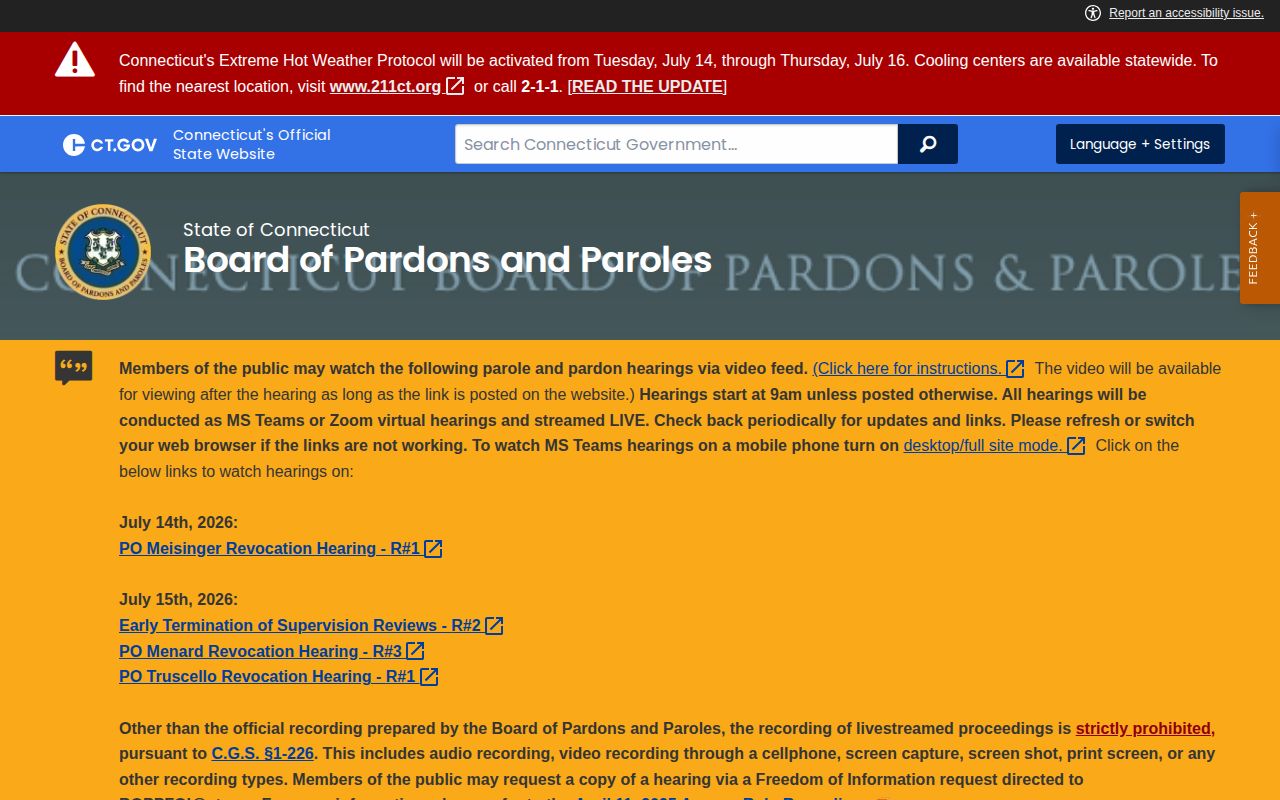
The captured Board page can help locate hearing information. A residential assignment still requires the person's DOC and supervision records.
Release planning may also address identification and property. CT DOC says identification that enters a facility is kept apart from other property and remains at the facility until discharge. Unclaimed identification stays at the discharging facility for thirty days, then can move to DOC Central Office for storage for up to two years. That record can help explain why a released person still needs to contact DOC after moving into the community.
Note: Reentry services support a transition, while the custody record and court order establish the actual date and legal terms of release.
Hartford Residential Status Changes
Community status can change after the first release. A person may complete residential placement and continue on ordinary parole, move to another approved setting, reach discharge, or return to custody after a violation process. The public record should be checked again whenever the date matters. An old release entry may remain true historically even if later custody has begun.
The Board of Pardons and Paroles can grant, deny, defer, rescind, or review parole-related matters. CT DOC and the court can document a violation or return to custody. The Hartford district office and Residential Services Unit handle different parts of the supervision structure. A stale jail roster is not a sound way to infer an absconder or violation status.
For an urgent parole absconder concern, CT DOC lists a Fugitive Investigations Unit at (203) 346-7830 and an anonymous tip email on its public page. Use that agency channel instead of attempting to locate a person through residential addresses. Emergency situations belong with emergency services.
Hartford Jail History and Placement
Hartford's old jail vocabulary can obscure the present record structure. Connecticut unified county jails and state prisons under CT DOC in 1968. Hartford Correctional Center later opened in 1977 as a state pretrial facility for adult men. The older Seyms Street jail history helps explain why people still search county-jail phrases, but modern release and residential records do not belong to an old sheriff system.
The Residential Services Unit itself is not presented as a historic jail. Its role is modern post-release supervision. History matters because it directs the search to the right current agencies: Hartford Police for local arrest records, CT DOC for custody and discharge, the Board for parole process, the Judicial Branch for court and probation terms, and Residential Services for structured community placement.
A clean record trail follows the person across those systems without turning each move into “release.” Secure custody ends at one point. Residential supervision can begin next. Final discharge may come later. Naming each stage is the surest way to avoid a false conclusion.