
Hartford Projected and Actual Release
An estimated release date, often shortened to ERD in CT DOC directive material, is the current result of sentence data and applicable credit. An actual release date records a completed event. These are not the same. CT.gov warns that public status may lag, release dates can change, and not all changes are processed at once. A future date should therefore be described as estimated, projected, or scheduled.
Pretrial custody works another way. Hartford Correctional Center holds many people whose cases have not reached sentence. Bond, a promise to appear, a court order, a new warrant, or case disposition may determine when they leave. There may be no DOC sentence date to calculate. A person held at Hartford can also have a case in Bristol, Enfield, Manchester, Middletown, New Britain, Rockville, West Hartford, or Hartford because the facility serves all of those superior courts.
- Estimated Release Date
- The date calculated from the controlling sentence and current credit information.
- Jail credit
- Credit for qualifying time held before or during sentence.
- Detainer
- A hold or request from another authority that can alter where a person goes at release.
- Parole eligibility
- The point when review may occur, not a guaranteed release date.
Find a Hartford Projected Release Date
Start with facts that distinguish the record. A CT DOC number is more precise than a name. Date of birth helps when several people share a surname. For a Hartford Police arrest, the case number and arrest number can point to the court or DOC trail. A federal register number belongs in the BOP locator, not the Connecticut search.
- Determine whether the person is pretrial, state sentenced, on parole, in federal custody, or held through immigration authority.
- For Connecticut custody, open the CT DOC Inmate Information Search. Search by DOC number when possible, or use last name, first name, and date of birth.
- Read the current facility, status, and any release-date language together. A current facility usually means the person remains in CT DOC custody.
- Check the Judicial Branch docket for the sentence, bond order, jail credit, probation, violation, or later sentence change.
- If the displayed date seems wrong, contact CT DOC Public Information or Sentence Calculation and Interstate Management. Ask whether the field is estimated and what record controls it.
- Use VINE for a custody-change alert, then verify the event in DOC or court records.
The full custody and release-record route is available from the Hartford County released inmates search. It is useful when the person does not appear in CT DOC or the last known custody source is unclear.
Note: A missing Connecticut result can mean police-only custody, a spelling issue, another system, a restricted record, or a delayed update.
Hartford DOC Release Search Fields
Connecticut's public search accepts a CT DOC inmate number, last name, first name, and date of birth. Search indexing advises that an inmate number alone, or the first few letters of the last name, may improve results. That helps when a surname is hyphenated or appears with a different spelling. Use the fewest facts needed to find candidates, then narrow with birth data and DOC number.
| Field | Best use | Caution |
|---|---|---|
| CT DOC inmate number | Exact state-custody match | Do not confuse it with a Hartford arrest number |
| Last name | Broad person search | Try a short prefix for spelling variants |
| First name | Narrow multiple matches | Formal and common names may differ |
| Date of birth | Separate similar names | Confirm it from a sound source |
| Status and facility | Read present custody | May lag a recent change |
| Release-date language | Read the present estimate or past event | Exact live labels can vary |
For a short Hartford Police custody event that never became a DOC remand, the state record may add little. Use the police arrest identifiers and court docket instead. The local log is an arrest source, not a release-date calculator.
Hartford Sentence Calculation Records
The CT DOC Sentence Calculation and Interstate Management Unit oversees Central Records, Interstate Compact functions, and Risk Reduction Earned Credits. Central Records manages sentence calculation and provides technical help on time-calculation questions. The RREC office trains, audits, and reviews eligible people as part of the discharge-review process.
This office is the state fallback when a public date conflicts with a judgment or known jail credit. A useful inquiry identifies the person and asks about the controlling sentence, credited time, RREC treatment, detainers, and whether the displayed date is estimated or final. The facility itself may know a release plan, but Central Records maintains the calculation behind the date.
Keep copies of the judgment or mittimus, which is the court order that sends a sentenced person into custody, and any later sentence modification. Those records help explain a mismatch without assuming that the public screen is wrong.
Hartford Earned Credit Release Rules
Risk Reduction Earned Credit is governed by Connecticut General Statutes Section 18-98e. Eligible people may earn credit through adherence to an offender accountability plan, qualifying programs and activities, and good conduct. Good conduct alone is not enough. The commissioner or designee may revoke all or part of the credit for misconduct, refusal to follow required programs, or other good cause.
CT DOC's older RREC explanation describes a maximum of five days per month for eligible offenders. That maximum is not an automatic monthly award. Program participation, conduct, eligibility, and later loss all matter. Administrative Directive 4.2 connects the credit system with the Estimated Release Date concept.
The official earned-credit source is shown below through its CT DOC page.
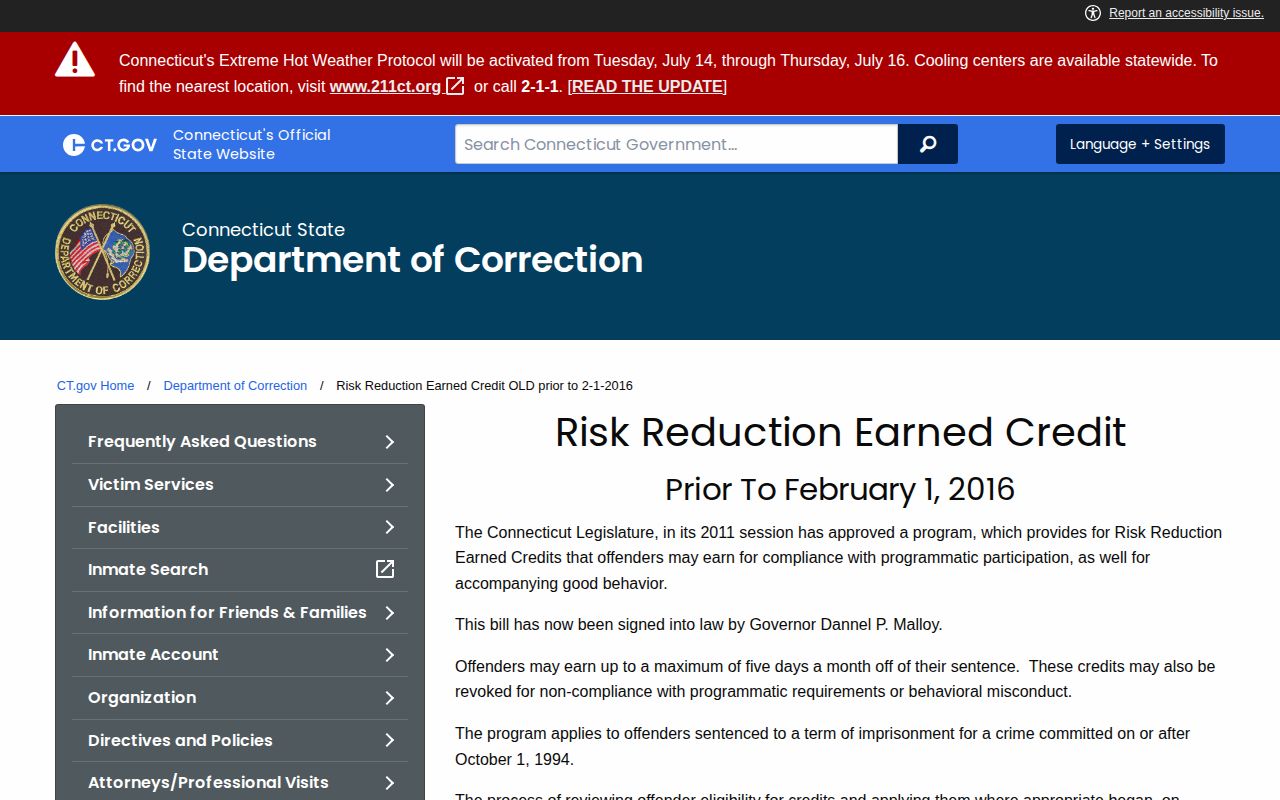
The policy context explains why two people with similar sentence lengths can have different estimates.
Note: Earned credit can change a calculation, but it does not override a detainer, court order, or separate controlling sentence.
Hartford Release Date RREC Twist
Parole eligibility and estimated discharge are separate clocks. The Board of Pardons and Paroles says people serving a definite total effective sentence of at least two years and one day may generally be considered for parole. Many nonviolent sentences use a 50 percent eligibility point, less applicable jail or risk reduction credits. Violent offenses involving use, attempted use, or threatened use of force generally require service of 85 percent, less jail credit.
The key Connecticut rule is narrow but important. For offenses committed on or after July 1, 2013, RREC does not reduce the parole eligibility date for the 85 percent group. Credit may still matter to another sentence calculation, yet it cannot be used to promise earlier parole review in that category. The BOPP parole eligibility page and Section 54-125a control the public explanation.
The captured parole eligibility statute appears below.
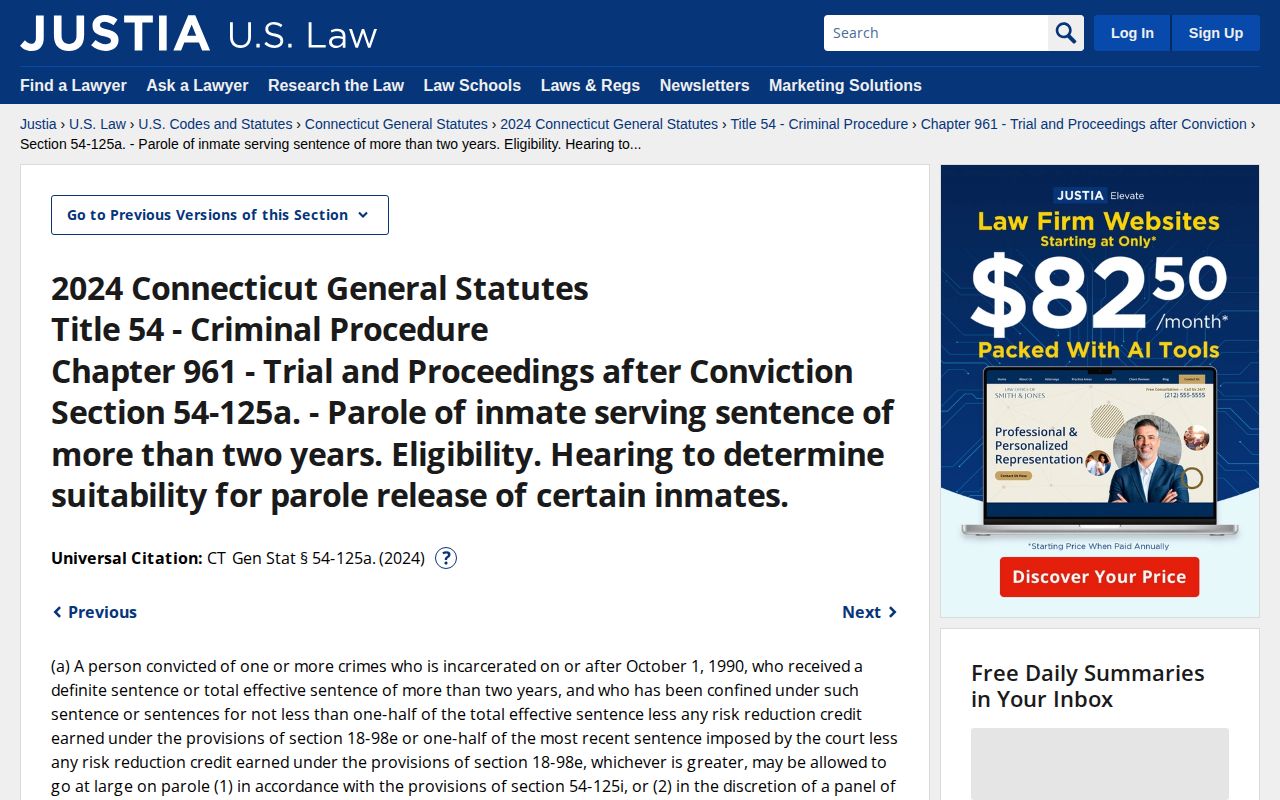
Read the statutory threshold as an eligibility marker, then look for the Board's actual action and the DOC release status.
Why Hartford Release Dates Change
A projected date is recalculated when a fact feeding the sentence changes. Some updates shorten the estimate. Others extend it or change the destination at release. A public page can also appear unchanged while staff process new information. That is why the date, status, and source-view time should be saved together.
| Factor | Possible effect | Record to check |
|---|---|---|
| Jail credit correction | Moves the calculation after qualifying time is added or removed | Court judgment and CT DOC Central Records |
| RREC earned or lost | Changes eligible sentence credit | CT DOC sentence calculation |
| New sentence or violation | Adds or changes the controlling term | Judicial Branch docket |
| Detainer or warrant | Changes transfer or release destination | DOC, court, or holding agency record |
| Parole action | Grant, denial, deferral, rescission, or revocation changes the path | BOPP and CT DOC status |
| System processing | Creates a short lag between event and public display | Direct agency confirmation |
A transfer is not a release. If someone leaves Hartford Correctional Center for York, another CT DOC facility, federal custody, or an immigration hold, the Hartford location changes but custody continues. Read the destination and authority before treating the date as community release.
Hartford Release Dates by Custody
Connecticut DOC is the main route for Hartford Correctional Center and state sentences. A Hartford Police-only arrest may instead turn on bond and a court order. A federal sentence belongs in the BOP inmate locator, which warns that federal dates may change with time-credit recalculation. ICE custody belongs in the ICE locator and field-office channel.
BOP explains that a past release date with no listed facility means the person left BOP custody on that date. Even then, another form of custody or federal supervised release may remain. ICE status can follow a state release, so “released from Hartford” may mean transfer to another agency rather than return to the community.
Confirm Hartford Release Date Changes
Use Connecticut VINELink notifications to watch for a reported custody change. VINE is an alert source, not the sentence record. When a notice arrives, compare it with CT DOC status and the court docket. If sources conflict, contact CT DOC Public Information at (860) 692-7780 during its listed weekday hours, or write to 24 Wolcott Hill Road, Wethersfield, CT 06109.
Ask a narrow question. Provide the DOC number, full name, date of birth, displayed date, and time the page was viewed. For a police-only event, call Hartford Police Records at (860) 757-4150 and use the arrest and case numbers. For a parole date, check the Board record and DOC status. A past actual release should be documented as a completed event; a future date should remain labeled as projected.
Note: Keep the source date with any saved release estimate because later credit, court, parole, or processing changes may replace it.