
Hartford Parole and Probation Compared
Parole is release from a prison term to community supervision under correctional authority. Special parole is a court-imposed period that begins after the prison portion of a sentence. Connecticut links these statuses to the Board of Pardons and Paroles and the CT DOC Division of Parole and Community Services. Probation is different. It is a court sentence supervised through the Connecticut Judicial Branch Court Support Services Division, often after a suspended jail term or as part of the judgment.
One person can move through more than one status. Someone may leave Hartford Correctional Center on parole, complete that term, and have a separate court condition. Another person may leave on bond with no parole at all. A current jail roster cannot resolve these facts because it is built to show custody, not the full sentence after release.
| Point | Parole or special parole | Probation |
|---|---|---|
| Legal source | Parole decision, DOC authority, or special-parole sentence | Court judgment |
| Main record path | CT DOC status, BOPP material, Parole and Community Services | Judicial Branch case docket and CSSD |
| Local route | Hartford district or Residential Services Unit | Sentencing court and adult probation channel |
| End point | Discharge or approved early termination | Completion, court modification, or discharge |
- Discharge
- The formal end of custody or supervision.
- Absconder
- A supervised person reported as having left supervision without authorization.
- Detainer
- A request or hold from another authority that may affect custody or release.
Verify Hartford Post-Release Supervision
Begin with a firm identifier. A CT DOC inmate number is best for a person who entered state custody. A docket number is strongest for probation. Name and date of birth help separate people with similar names. Hartford Police arrest numbers can connect a local arrest to the later court or DOC record, but an arrest log alone does not prove parole or probation.
- Search the CT DOC Inmate Information Search by DOC number or name. Read the status and facility fields with care.
- Check the Judicial Branch criminal case record for the judgment, sentence, probation term, or violation proceedings. The docket is the key source for court-ordered probation.
- Review the BOPP hearing calendar when parole consideration, revocation, or early termination is relevant.
- Use CT DOC Parole and Community Services to identify the correct district or special unit.
- Call the local office only after gathering identifiers. Ask whether the office can confirm or route a public status inquiry.
The broader released-person search and record path is set out on the Hartford County released inmates home page. That path helps when the custody type is not yet clear.
Note: CT.gov cautions that DOC status changes may not appear at once, so confirm a current supervision question with the responsible office.
Hartford Supervision Offices After Release
Hartford has two named CT DOC supervision offices on Sheldon Street. The district office handles local parole and community-supervision routing. The Residential Services Unit matters when release includes a halfway house, structured placement, or another residential-services plan. Neither office is a jail. A person assigned there has moved from secure custody into a community or residential supervision channel.
Hartford Parole and Community Services300 Sheldon Street
Hartford, CT 06106
Phone: (860) 297-4400
Fax: (860) 297-6599 Residential Services Unit
286 Sheldon Street
Hartford, CT 06106
Phone: (860) 297-4400
Fax: (860) 297-6523
The official Hartford district directions page confirms the first office. CT DOC also maintains a separate Residential Services Unit page. Use the address shown on the status or release plan when it is available. Do not assume every Hartford release reports to the district office.
Hartford Parole Hearing Records
The Connecticut Board of Pardons and Paroles is the decision source for parole matters. Its calendar posts date-specific virtual hearing links. Hearings generally start at 9:00 a.m. unless a posting says otherwise, and links can change by date. The calendar may include parole reviews, revocation hearings, and early-termination reviews. No separate searchable decision database was found in the Hartford research, so an old calendar entry should not be treated as a final outcome.
The Board states that viewers may not record a livestreamed proceeding except through the official recording process. Its page cites Connecticut General Statutes Section 1-226. A member of the public can request a hearing copy by an FOI request to BOPPFOI@ct.gov. The hearing page, a posted recording while available, a formal request, and the later DOC status together form the sound verification chain.
The official BOPP hearing calendar is shown in the captured source below.
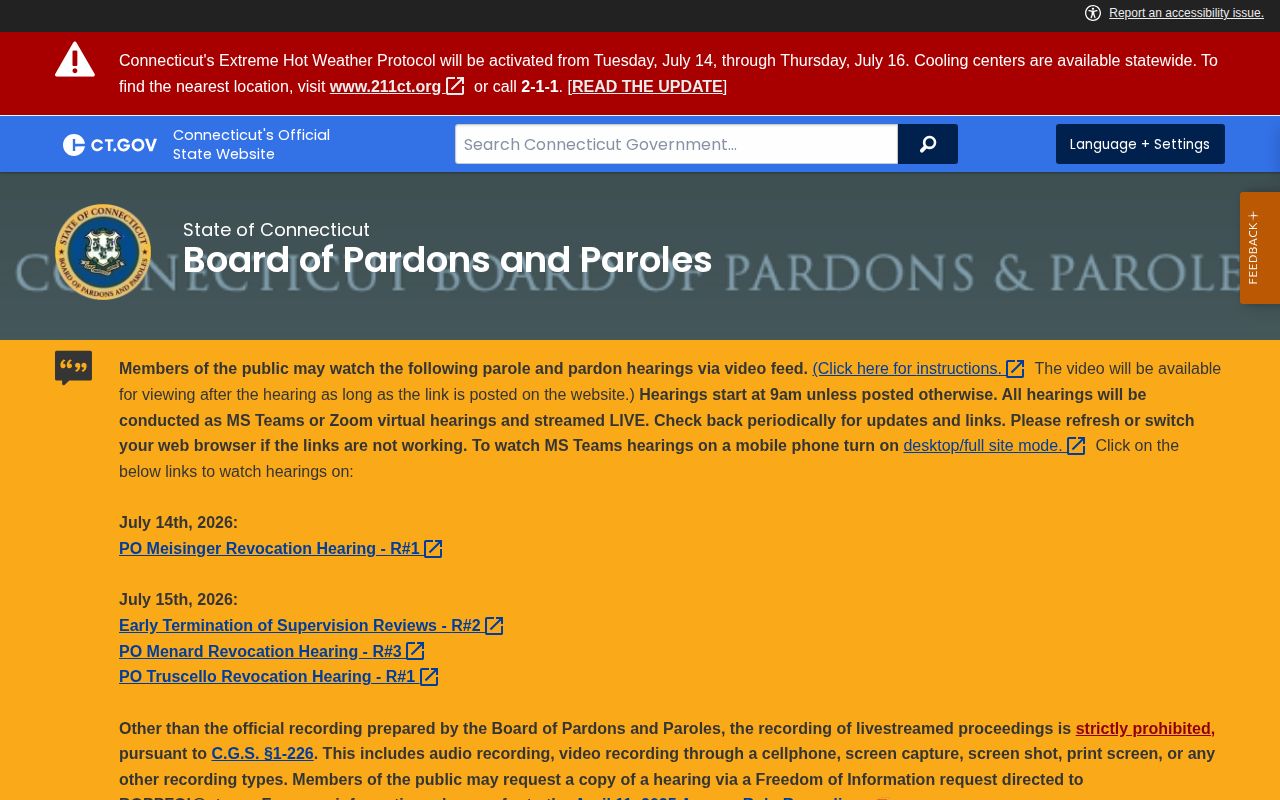
The date-specific layout is why a person should record the hearing date and review type before requesting an official copy.
Hartford Parole Eligibility Rules
Eligibility is not a release order. Under Connecticut General Statutes Section 54-125a and the Board's published framework, people serving a definite total effective sentence of at least two years and one day may generally reach parole consideration. Many nonviolent cases use a 50 percent threshold, less applicable jail or risk reduction credits. Offenses involving the use, attempted use, or threatened use of physical force generally use an 85 percent threshold, less jail credit.
For offenses committed on or after July 1, 2013, Risk Reduction Earned Credit does not reduce the parole eligibility date for the 85 percent group. Some offenses are generally ineligible, subject to statutory exceptions. The BOPP eligibility page is the best public explanation, but a calculation question belongs with CT DOC sentence records and the Board.
The source image below comes from that official eligibility material.
It separates the date on which review may occur from the Board's later decision to grant, deny, or defer release.
Note: Parole eligibility marks when review can occur; it never guarantees that Hartford post-release supervision will begin on that date.
Hartford Reentry Before Parole Release
CT DOC documents a structured reentry path before release. Its Offender Reentry Services material says each facility has a full-time Reentry Counselor. More focused planning starts 18 months before release. Reentry staff coordinate with Parole and Community Services and the Judicial Branch Court Support Services Division, the same split that matters when parole and probation obligations overlap.
Hartford and Waterbury welcome centers are referenced through Community Partners in Action. These services can help with the move from secure custody to the community, but they do not certify release status. Use the DOC record, court docket, or supervision office for proof. Reentry services are best treated as a practical route after the legal status has been confirmed.
Hartford IDs After DOC Discharge
Identification documents are handled apart from other property in CT DOC custody. DOC states that identification entering a facility remains there until discharge. If a discharged person does not claim the IDs, the discharging facility holds them for 30 days. The documents then go to DOC Central Office and may remain there for up to two years.
For an ID believed to be at Central Office, the published contacts are 860-692-6836, 860-692-7869, and DOC.ORSU@ct.gov. This issue is distinct from verifying parole or probation, yet it often arises at the same point. The correct approach is to first identify the discharging facility, then ask whether the ID is still there or has moved to Central Office.
Note: Property location does not prove active supervision; it only shows where CT DOC may hold unclaimed identification after discharge.
Hartford Parole Absconder Concerns
An absconder is a person reported as having left supervision without approval. A stale jail screen cannot establish that status. CT DOC Parole and Community Services lists a Fugitive Investigations Unit at (203) 346-7830 and an anonymous tip email, Stephen.Faiella@ct.gov. That unit is the appropriate route for parole or community-supervision fugitive concerns.
Do not infer a warrant from a missed appointment, a social post, or the absence of a person from a roster. The supervising authority determines whether a violation exists. A parole violation can lead to a warrant, custody, a revocation hearing, continued supervision, or another official response. Probation violations run through the court and CSSD path instead. If the issue is immediate danger, use emergency services rather than a records inquiry.
Hartford Supervision Discharge Records
Supervision ends through an official act, not merely the passage of an expected date. Parole may end at discharge or through approved early termination. Probation may end when the court term is completed, modified, or discharged. A revocation or new court order can change that path. Ask for the record that identifies the authority, status, and effective date.
For parole, use BOPP and CT DOC records. For probation, use the Judicial Branch docket and the sentencing court or CSSD. VINE may show a custody change, but it is not a discharge certificate. Keep the DOC number, docket number, full name, and date of birth with any request. Those details reduce the risk of mixing two Hartford records.